بِسْمِ اللهِ الرَّحْمٰنِ الرَّحِيْمِ
Alhamdulillahi Rabbil ‘Alameen, wassalatu wassalamu ‘ala Rasulillah.
نحمده ونستعينه ونستغفره، ونعوذ بالله من شرور أنفسنا ومن سيئات أعمالنا…
Introduction: The Reality We Cannot Ignore
Respected brothers and sisters, today, we are living in a time of constant noise and constant crisis.
Every day, we see headlines:
of injustice
of discrimination
We see:
rising Islamophobia,
attacks on civil rights,
and growing division in our societies.
and communities under pressure—whether here in the United States or abroad.
We are living in a time:
when injustice is not hidden—it is visible…
it is repeated…
and it is felt across our Ummah.
In recent years, there have been moments that have shaken the conscience of the world.
- In Palestine in the Gaza strip, we have witnessed devastation on a scale that is difficult to comprehend—families displaced, entire neighborhoods reduced to ruins, and hundreds of thousands of lives lost while the world watched a genocide unfold in real time.
- In India, the country where I was born, millions of Muslims face growing marginalization, systemic injustice, discrimination, and challenges to their identity, security and dignity. We have seen homes of Muslim families demolished within hours—sometimes without due process—leaving entire families standing in the rubble of what was once their أمن… their safety… their dignity.
- We are seeing individuals targeted daily based on their identity—detained, silenced, or publicly vilified—simply for who they are.
- We have seen hate speech normalized… discrimination institutionalized… and fear becoming a daily reality for many.
- Just recently, in India, millions of people—many from minority communities—were removed from voter rolls ahead of a major election. In some areas, entire communities lost their ability to participate in the democratic process, despite having valid documentation.
- And these are not an isolated issues. Reports from international and human rights organizations have also highlighted patterns of discrimination, including forced evictions, hate speech, and unequal treatment affecting Muslim communities in different parts of India.
And yet, perhaps what is even more painful than the ظلم itself…
is how quickly the world moves on.
How quickly injustices become headlines…
and then become forgotten.
Brothers and sisters, when we hear these stories, it is easy to feel distant.
To think—this is happening far away.
But the reality we cannot ignore is,
that the same forces that fuel injustice there…manifest in different ways here in the United States.
We are witnessing the normalization of hate and injustice.
Islamophobia is no longer on the margins; it has taken roots here and abroad.
We see bias, we see suspicion,
we see fear-driven narratives shaping how our faith is perceived.
And we feel the pressure—
subtle at times…and overt at others—
to dilute who we are.
And perhaps most concerning…
a growing apathy to human suffering.
Different forms…but the same اختبار… the same test.
In fact, recent reports show record levels of anti-Muslim complaints, affecting workplaces, public spaces, and everyday life.
And in the face of all of this…
many of us feel overwhelmed.
We tell ourselves:
the problem is too big…
someone else will take care of it…
there’s nothing I can do.
And sometimes, we remain silent out of fear.
Upholding Justice
Brothers and sisters, it is easy to feel overwhelmed in the face of so much injustice.
But our faith teaches us that we are never meant to be bystanders when we witness wrong.
As it has been said: “It only takes good people to do nothing for evil to prevail.”
Our deen does not allow us to remain passive. Allah ﷻ also reminds us in the Qur’an:
۞ يَـٰٓأَيُّهَا ٱلَّذِينَ ءَامَنُوا۟ كُونُوا۟ قَوَّٰمِينَ بِٱلْقِسْطِ شُهَدَآءَ لِلَّهِ وَلَوْ عَلَىٰٓ أَنفُسِكُمْ أَوِ ٱلْوَٰلِدَيْنِ وَٱلْأَقْرَبِينَ ۚ
“O you who believe, stand firmly for justice, as witnesses for Allah—
even if it be against yourselves, your parents, or your relatives.” (Surah An-Nisa 4:135)
This ayah is not just a command—it is a definition of who we are as Muslims.
We are not a people who turn away from injustice.
We are not a people who remain silent in the face of ظلم.
We are a people who stand—with truth, with courage and faith
The First Lesson: It Begins with Character and Courage
This responsibility is not abstract.
It is grounded in our tradition—and in the character of our beloved Prophet ﷺ.
When the revelation first came to our beloved Prophet ﷺ, he was shaken.
He was afraid. Uncertain. Overwhelmed.
The Prophet ﷺ returned to his home, his heart trembling, and went to Khadijah (رضي الله عنها) and said,
‘Wrap me up, wrap me up!’
So they wrapped him until his fear subsided.
He then said to Khadijah, ‘O Khadijah, what has happened to me?’ and informed her of what had occurred, saying, ‘I fear for myself.’
In that moment of vulnerability, it was Khadijah (رضي الله عنها) who responded—not with doubt, but with certainty.
And what did Khadijah (ra) say?
She didn’t say: Pray more.
She didn’t say: Fast more.
She said:
“Never! Be reassured.
By Allah, He will never humiliate you.
By Allah, you maintain family ties, you speak the truth, you bear the burdens of others, you help the destitute, you honor your guests, and you support those afflicted by hardship.”
Think about that. The first validation of prophethood was not ritual.
It was character.
It was service.
It was standing for people.
She connected character to courage.
She reminded him that those who live for justice and الخير are never abandoned by Allah.
She was also the first to believe in him and in his message, providing critical emotional, spiritual, and moral support at the start of his prophethood.
So brothers and sisters, before we talk about changing the world— we must ask:
Are we building the character required to stand for justice?
Because true courage does not begin in public… it begins within.
The Second Lesson: Standing for Justice Beyond Ourselves
The second lesson is the Prophetic Model
Action Over Fear
Standing for Justice Even When It’s Risky
Brothers & Sisters, the example of the Prophet ﷺ did not stop at personal character.
It extended into action within society.
There was a remarkable alliance in pre-Islamic Mecca known as Hilf al-Fudul—the Alliance of the Virtuous.
It was formed in what was called the “Age of Ignorance”…
a time without systems of justice, without courts, without protection for the weak.
And what sparked it?
A simple act of injustice.
A Yemeni merchant was cheated by a powerful leader.
He had no tribe. No support. No voice.
So he stood on a hill and cried out for justice.
And a group of people—led by individuals of conscience—answered that call.
They gathered in the home of Abdullah ibn Jud’an and made a pledge:
👉 To stand with the oppressed
👉 To uphold justice—no matter who the oppressor was
👉 To defend rights—regardless of tribe, status, or origin
And among those present… was a young man, around 20 years old. Muhammad ﷺ.
Years later, after becoming the Messenger of Allah ﷺ, he reflected on that moment and said:
“I witnessed a pact in the house of Abdullah ibn Jud’an that I would not trade for the finest wealth. And if I were called to it today, I would respond.”
Think about that.
This was not an Islamic treaty.
It was not a religious obligation at the time.
But it was justice.
And the Prophet ﷺ honored it.
SubhanAllah. This tells us something powerful:
👉 Justice is not optional.
👉 Standing for the oppressed is part of our Deen.
👉 And doing the right thing does not wait for perfect conditions
Even before revelation…
The Prophet ﷺ was already already an activist for justice,
a servant of his community,
and a protector of the oppressed.
Brothers and sisters, If the Prophet ﷺ stood for justice in Makkah—
what is our excuse today?
When we look at the struggles and injustice to our communities here and abroad.
And yet, despite all of this, one of the greatest dangers we face is not just injustice…It is apathy.
The feeling that:
“This doesn’t affect me”,
“Someone else will handle it”,
“My voice won’t make a difference”
But brothers and sisters, Apathy is not neutrality. Apathy is surrender.
And Islam does not teach us to surrender to injustice.
The Third Lesson: Impact Is Not Measured by Size
Many of us think:
What can I do?
We are so small.
The problem is too big.
But the Prophet ﷺ taught us something extraordinary:
“If the Day of Judgment comes while one of you has a seed in his hand, let him plant it.”
Even if the world is ending…
Even if there is no time for it to grow…
You still plant the seed.
Why?
Because in Islam:
👉 You are not responsible for the outcome
👉 You are responsible for the effort
Nuh (AS) preached for centuries with little visible success—but he never stopped.
The Fourth Lesson: Never Despair
The Prophet ﷺ said:
“Whoever says the people are destroyed, he is the most destroyed of them.”
Despair is not an option.
Allah promises that truth will prevail.
Injustice may rise—but it does not last.
The Fifth Lesson: Be the One Who Stands Up
Allah tells us about a man from the family of Pharaoh—a man who believed but hid his faith.
At some point… he couldn’t stay silent anymore.
He stood up.
He spoke truth to power.
He risked everything.
And what happened?
In Surah Ghafir (40:45) Allah ﷺ says:

“So Allah protected him from the evil of their schemes. And Pharaoh’s people were overwhelmed by an evil punishment” (Qur’an 40:45)
This verse highlights divine protection for those who stand for truth and the ultimate ruin of tyrants.
And those who remained silent? They later said:
“We followed you—can you save us now?”
The Question for Us
Who do we want to be?
The ones who stayed silent?
Or the ones who stood up?
About IMAM
But Here Is the Truth. Moments of crisis are not just moments of fear.
- They are moments of responsibility.
- They are moments of courage.
- They are moments of leadership.
Brothers and sisters,
I am here today representing the Indian Muslim American Movement (IMAM), a youth-forward organization doing courageous work to confront the challenges and threats facing our community—both here and abroad—driven by hateful ideologies and the Islamophobia and injustices they perpetuate.
IMAM is a grassroots, non-partisan, 501(c)(3) nonprofit organization that works in partnership with civil rights and human rights organizations to mobilize the diaspora—particularly young people—and to advance evidence-based research and public education on the impact of such exclusionary and harmful ideologies on minority communities.
We come from a legacy.
We strive to carry forward the legacy of Indian Muslim freedom fighters—men and women whose faith fueled a vision of liberation for all, whose Indian identity was inseparable from their Muslim identity, and whose sacrifices uplifted their communities in India and across the global diaspora.
IMAM stands at the intersection of:
- Faith and justice
- Education and advocacy
- Community and action
Through collaboration with a broad coalition of partners, IMAM focuses on:
- Raise awareness through credible, evidence-based research
- Engage policymakers, institutions, and media
- Build coalitions with civil rights and human rights organizations
- Empower communities—especially youth—to lead
All aimed at raising awareness about discrimination, injustice, and the challenges facing marginalized communities—while encouraging informed, responsible participation in society.
And brothers and sisters, the vision is clear:
A future in which such harmful and exclusionary ideologies are widely understood and rejected, in which actors advancing exclusionary, far-right ideologies are no longer normalized within the civic, cultural, or political life, and where justice, dignity, and inclusion are upheld —both here in the United States and around the world.
Why This Work Matters
Because narratives shape policy.
Because policy shapes lives.
Because silence allows injustice to grow.
And because:
👉 If we don’t tell our story, someone else will tell it for us.
The Final Reminder
Many of us still think:
What can I do? I am just one person.
But the Prophet ﷺ taught us:
“The most beloved people to Allah are those who are most beneficial to others.”
And he ﷺ taught us:
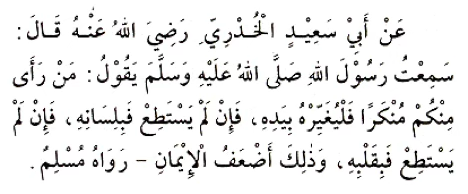
On the authority of Abu Sa’eed al-Khudree (ra) who said: I heard the Messenger of Allah (saw) say, “Whoso- ever of you sees an evil, let him change it with his hand; and if he is not able to do so, then [let him change it] with his tongue; and if he is not able to do so, then with his heart — and that is the weakest of faith.” [Muslim]
Not ignore it.
Not rationalize it.
Not wait for someone else.
👉 Change it.
Closing: Your Role
Yes—the problems are big.
But if you think you are too small to make a difference…
👉 Try sleeping in a room with a mosquito.
Be that mosquito.
At some point, you must step out of your comfort zone.
So my advice to myself and all of you is:
Do your part.
Support organizations and individuals who are striving to speak truth to power
Because in the sight of Allah:
It’s not about how big your impact is—
It’s about whether you showed up.
The Prophet ﷺ did not define courage only on the battlefield—
he defined it in the moral courage to speak truth.
The Prophet ﷺ said:
“The best form of struggle is a word of truth spoken to a tyrannical ruler.”
(Reported in Sunan Abu Dawood and Jami` at-Tirmidhi)
“We ask Allah ﷻ to grant us courage—not the courage to remain silent, but the courage to stand for truth and uphold justice.”